
1Why threat vs. solution?
Threat framing without efficacy information can induce fatalism; solution framing promotes engagement and policy support. Tracking the balance across large news corpora matters for climate communication research.
Manual coding does not scale. Two automated routes dominate: fine-tune an encoder on labelled data, or prompt an LLM with the coding guidelines.
RQ1 · Can zero-shot prompting match fine-tuned German encoders at sentence level?
RQ2 · How much does surrounding context help?
2Data
Two independent binary labels: a sentence can be threat-oriented, solution-oriented, both, or neither.
Neutral sentences undersampled to balance each task: 5,150 (threat) and 8,216 (solution) sentences.
3Two approaches, identical folds
A · Fine-tuned encoders
GBERT-large · GELECTRA-large (both 335M) · GeistBERT-base
Input: sentence pair
Four context windows
Training
- One classifier per task × model × window
- AdamW, lr 2–3·10−5, 10–15 epochs
- No domain-adaptive pre-training
B · Zero-shot prompting
No training, no examples: the model gets only the written coding guidelines
Prompt: six XML sections, in German
JSON, reasoning first (chain of thought)
Models · temperature 0
| Model | Params | Type | Weights |
|---|---|---|---|
| MiMo-V2.6-Flash | 309B/15B | MoE | open |
| Qwen3.8-27B | 27B | dense | open |
| Llama 4 Maverick | 400B/17B | MoE | open |
| Jev-1.13.0 | n/a | decision | closed |
Same five article-grouped folds for every model (stratified, ≈80/20): no article appears in both training and test data. Metric: weighted F1, mean ± SD across folds.
4Parity at the top; earlier prompting models stay below
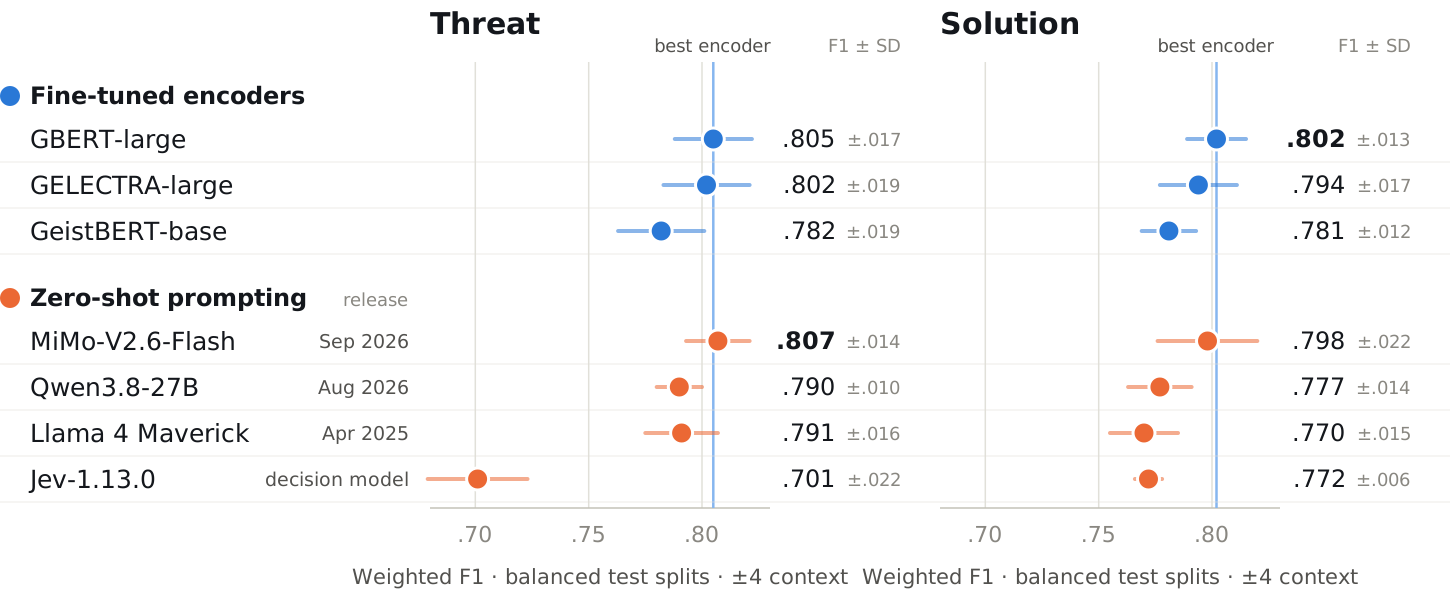
The top two differ by ≤ .004, well inside the fold SD (.013–.022): neither is superior. Llama 4 Maverick and Qwen3.8-27B only reach GBERT-large with ±1 context. Jev-1.13.0 (English-trained decision model) is stable on solution but weakest on threat.
5Context helps every encoder
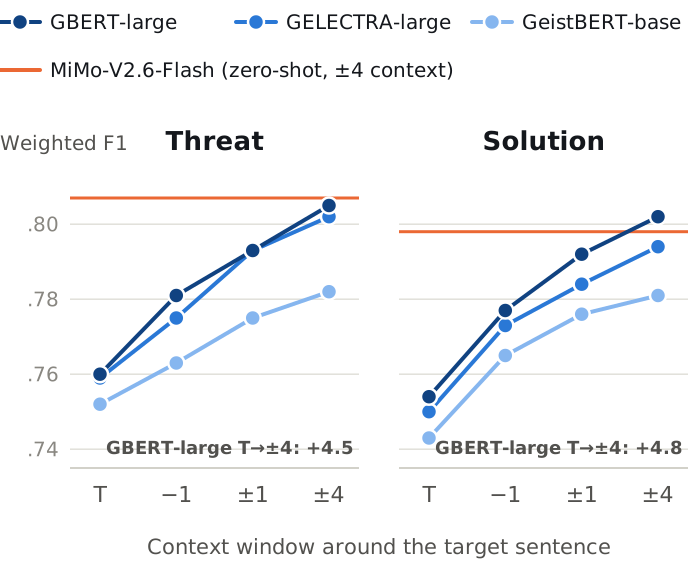
- Gains are monotonic for all encoders and both tasks.
- Biggest single step: adding the preceding sentence (+2.1 / +2.3 for GBERT-large).
- Model size matters more than pre-training objective: both large encoders are close; GeistBERT-base trails.
6On the real class distribution
Best encoder vs best prompting model on all 10,981 sentences (pooled over folds).
| Task | Model | Pos. F1 | Weighted | Macro |
|---|---|---|---|---|
| Threat | GBERT-large | .648 | .804 | .750 |
| MiMo-V2.6-Flash | .673 | .831 | .776 | |
| Solution | GBERT-large | .757 | .803 | .794 |
| MiMo-V2.6-Flash | .747 | .799 | .788 |
GBERT-large keeps high recall (.819 / .833) but loses precision (.536 / .694): trained on balanced data, it implicitly assumes a 50% base rate. Train on the natural distribution or adjust the threshold.
7Where the two disagree
On contested sentences exactly one model is right. Share of contested sentences each gets right:
Neither dominates. GBERT-large says “yes” more readily (recall .612 / .583); MiMo is more conservative, especially for threat (recall .388, precision .561).
Hard cases for both: sustainability, legislation, climate litigation, activism, and framing that only a wider context reveals.
8Take-aways
- Prompting is now a viable, low-cost alternative, even when labelled data exist.
- The gap closed only recently: re-run such comparisons as new models appear.
- Give encoders context: ±4 beats sentence-only for every model.
- Use agreement as a quality signal; route disagreements to manual coding.
- Encoders stay attractive where reproducibility and local execution matter.